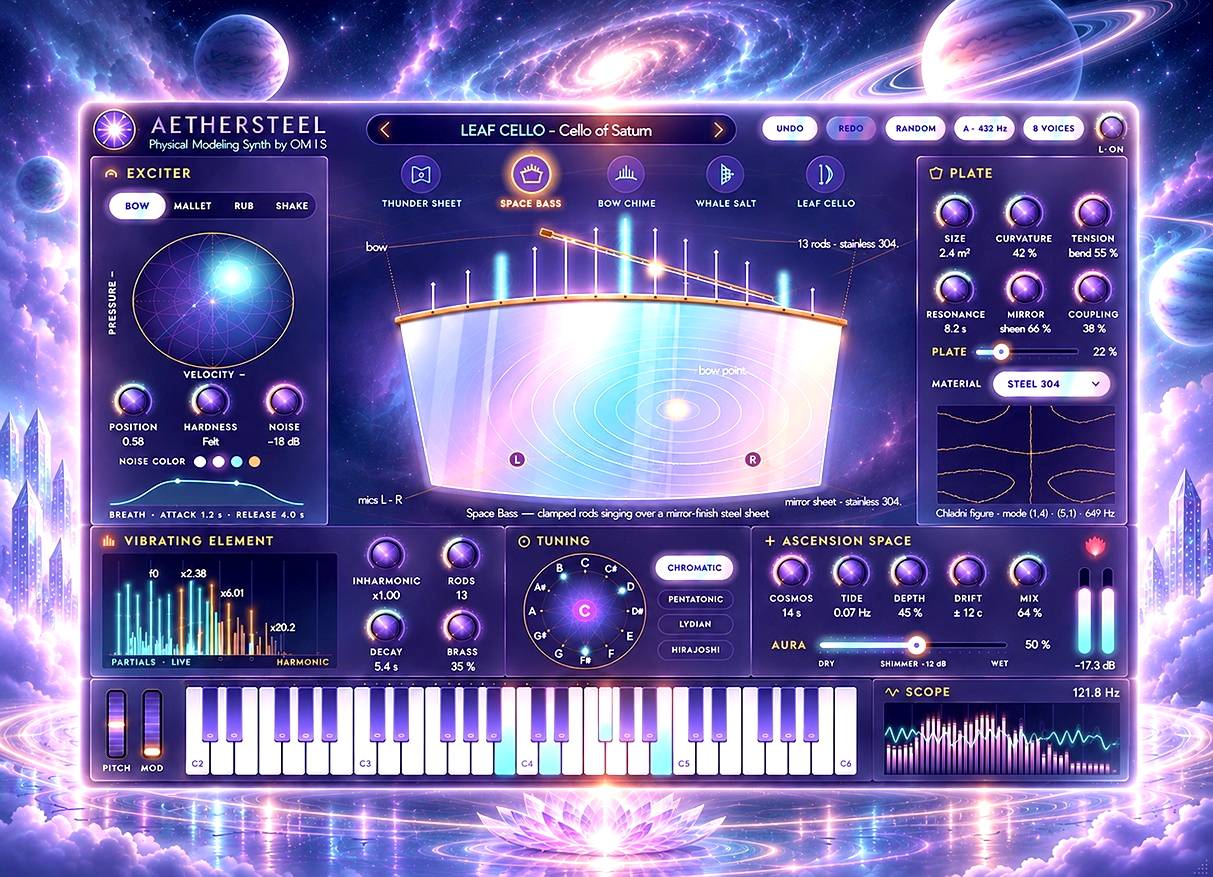
AETHERSTEELUnique Physical Modeling Steel Synth by OM IS
AETHERSTEEL does not play back recordings: it simulates, in real time, metal rods, sheets and strings that are
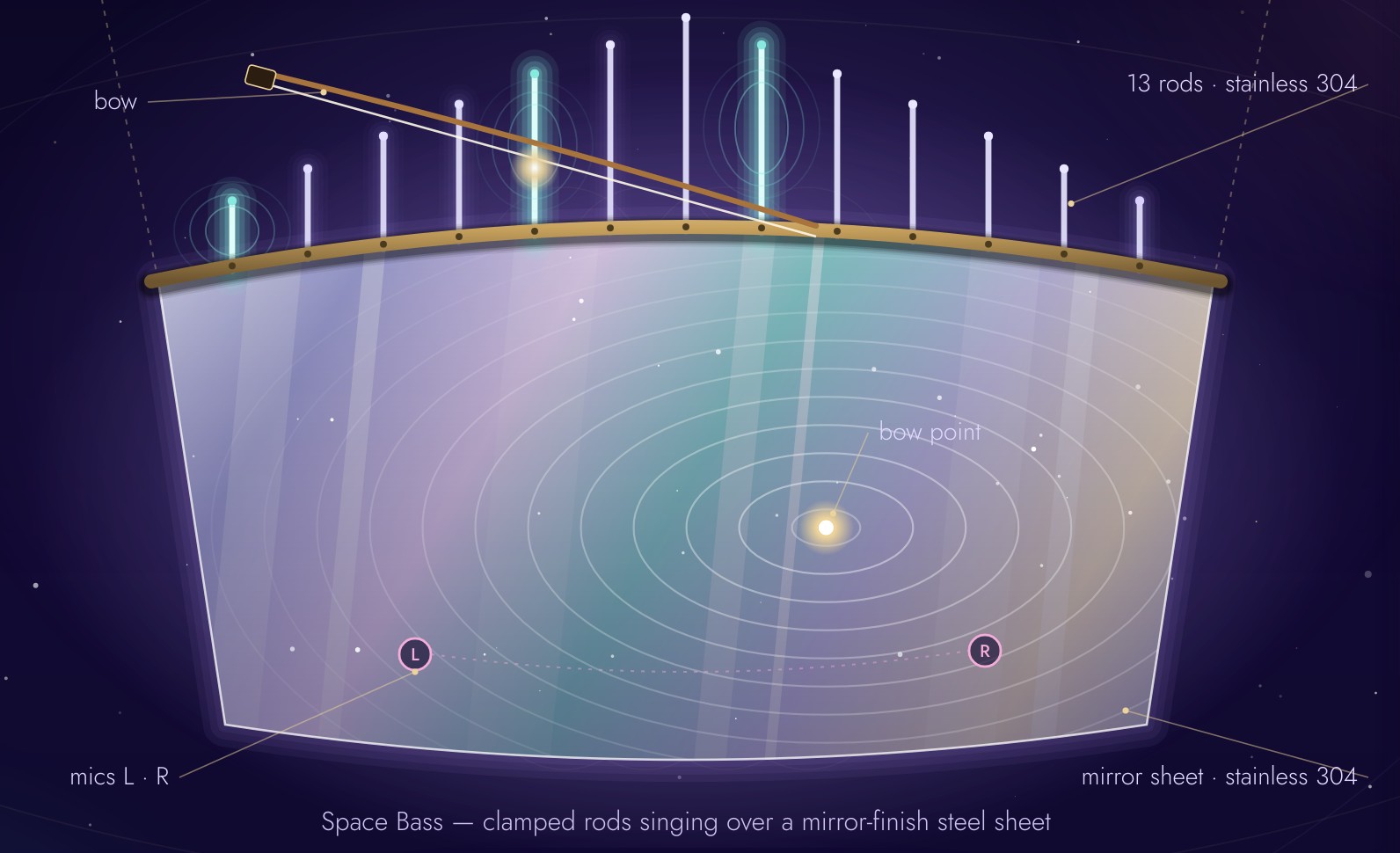
bowed, struck, rubbed or shaken. Inspired by the Space Bass and the Whale Sail of Constance Demby and by Robert Rutman's
steel cello, it lets you combine five instruments, four ways of playing them and eight materials, then pour the sound into a
resonant steel plate and the Ascension Space shimmer, where long chords bloom into a rising, celestial choir.
VST3 - Windows / macOS5 Instruments Models4 Tuning Scales4 Exciters
Nothing here is a recording.
Every rod, sheet and string is a modal model, a set of resonances with the frequencies, decays and couplings of real
metal, excited by a simulated bow, mallet, hand or shake. Change the material and the mathematics of steel becomes
that of brass, titanium or crystal.
01Sounds of metals
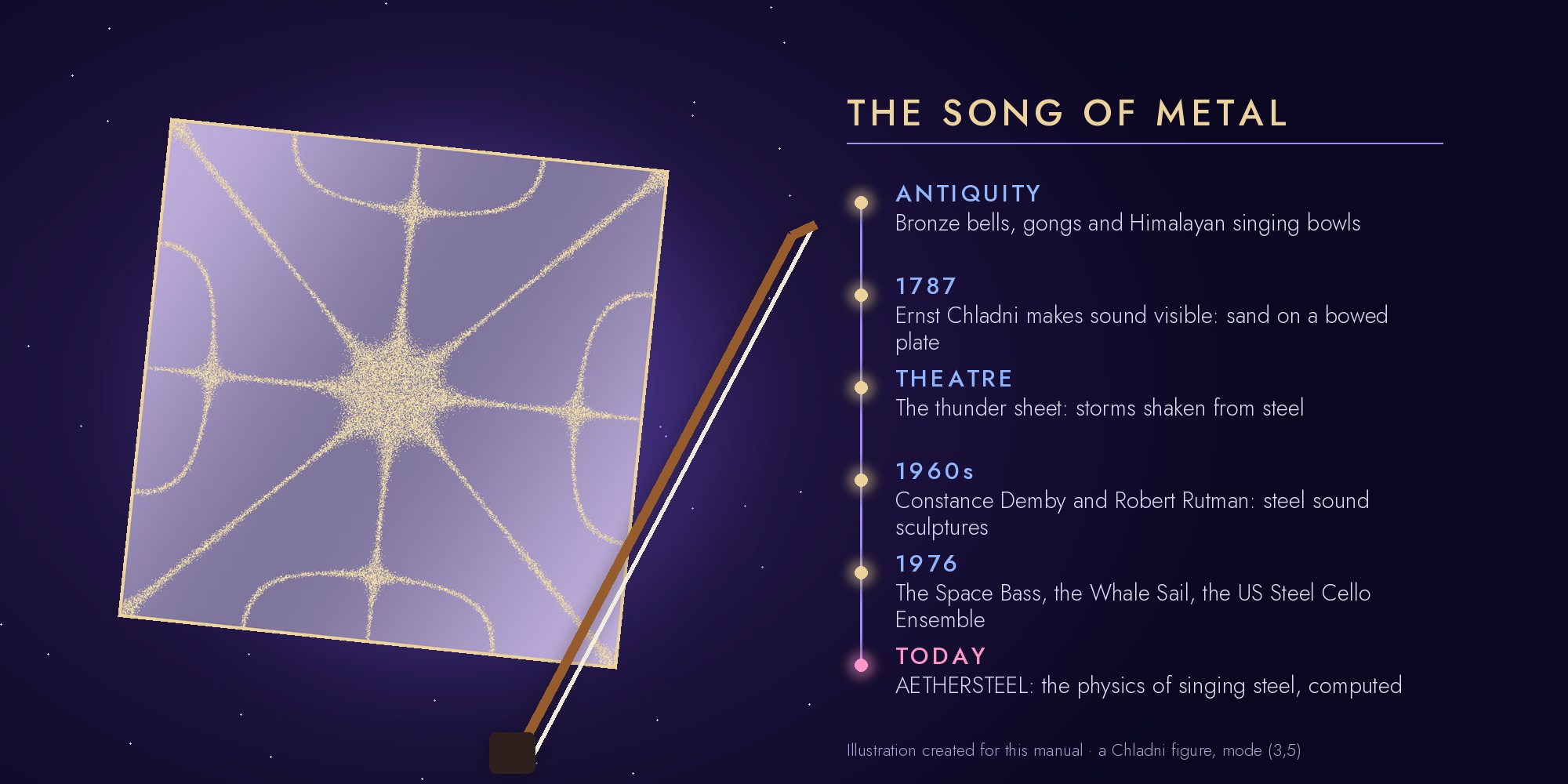
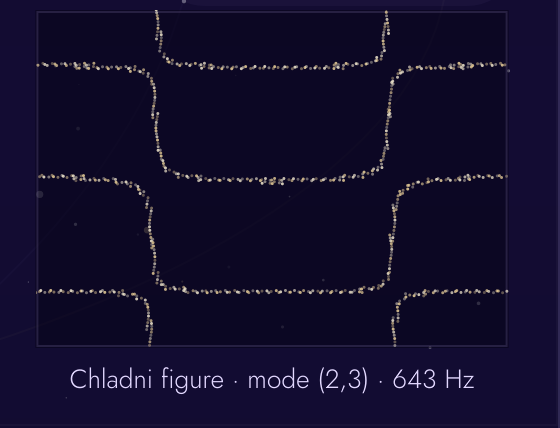
A Chladni figure of a bowed square plate, and the timeline that leads to AETHERSTEEL.
Metal has sung for humanity for thousands of years: bronze bells, gongs, and the Himalayan singing bowls traditionally
cast from an alloy of seven metals. Western theatres added their own voice, the thunder sheet, a large hanging
sheet of steel shaken behind the stage to conjure storms. And in the late eighteenth century the physicist
Ernst Chladni showed that a vibrating plate hides geometry: sand scattered on it gathers into elegant nodal patterns.
Constance Demby
Composer, painter and sculptor, and a pioneer of new age and space music. Her Space Bass is a ten-foot sheet
of mirror-finish stainless steel fitted with steel and brass rods, played with mallets and a bow across some five
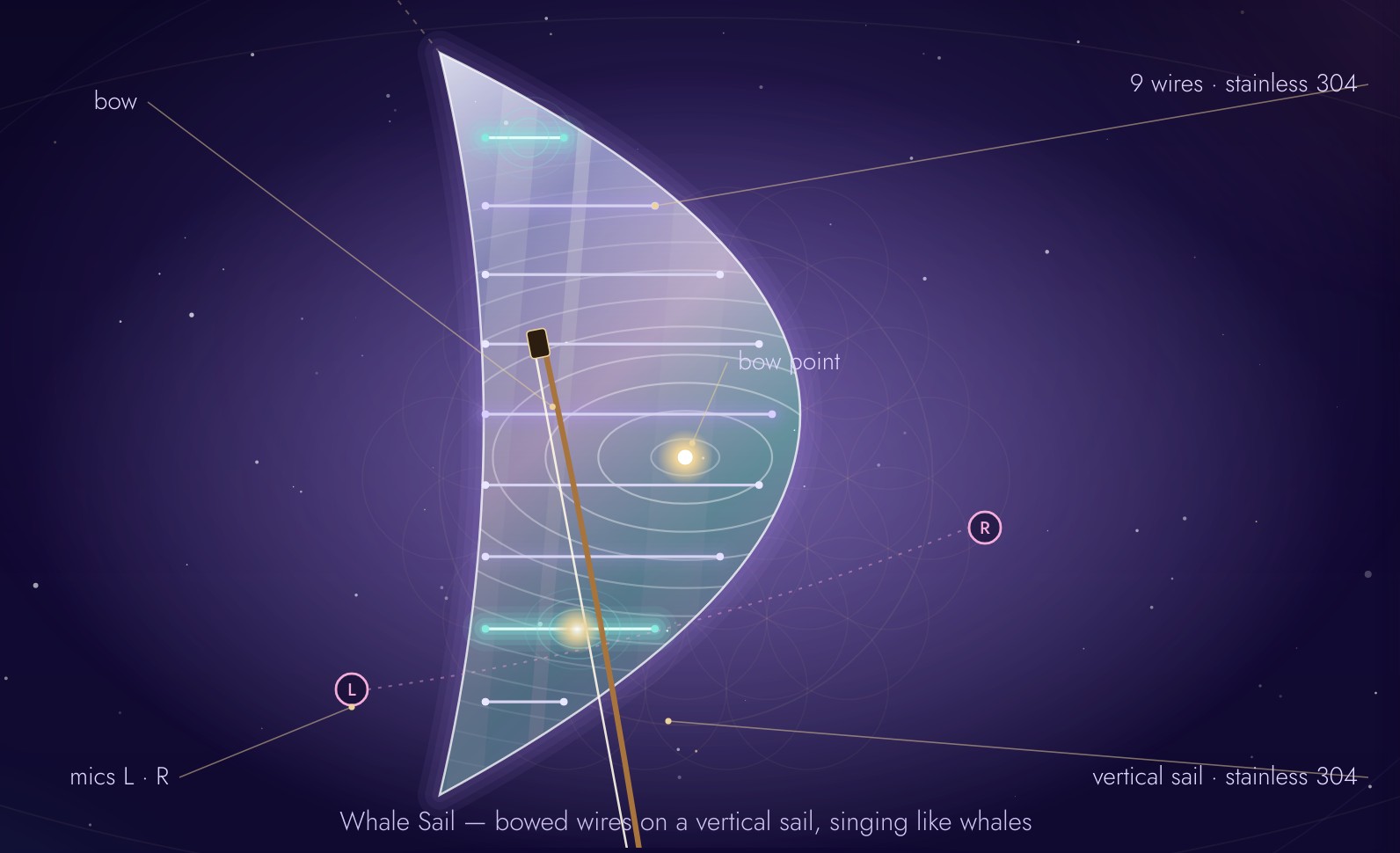
octaves. Its companion, the Whale Sail, is another bowed sheet-metal sculpture. They colour albums such as
Sacred Space Music and Novus Magnificat.
Robert Rutman
Painter, sculptor and instrument builder. In the 1960s he and Demby collaborated in New York on steel sound sculptures.
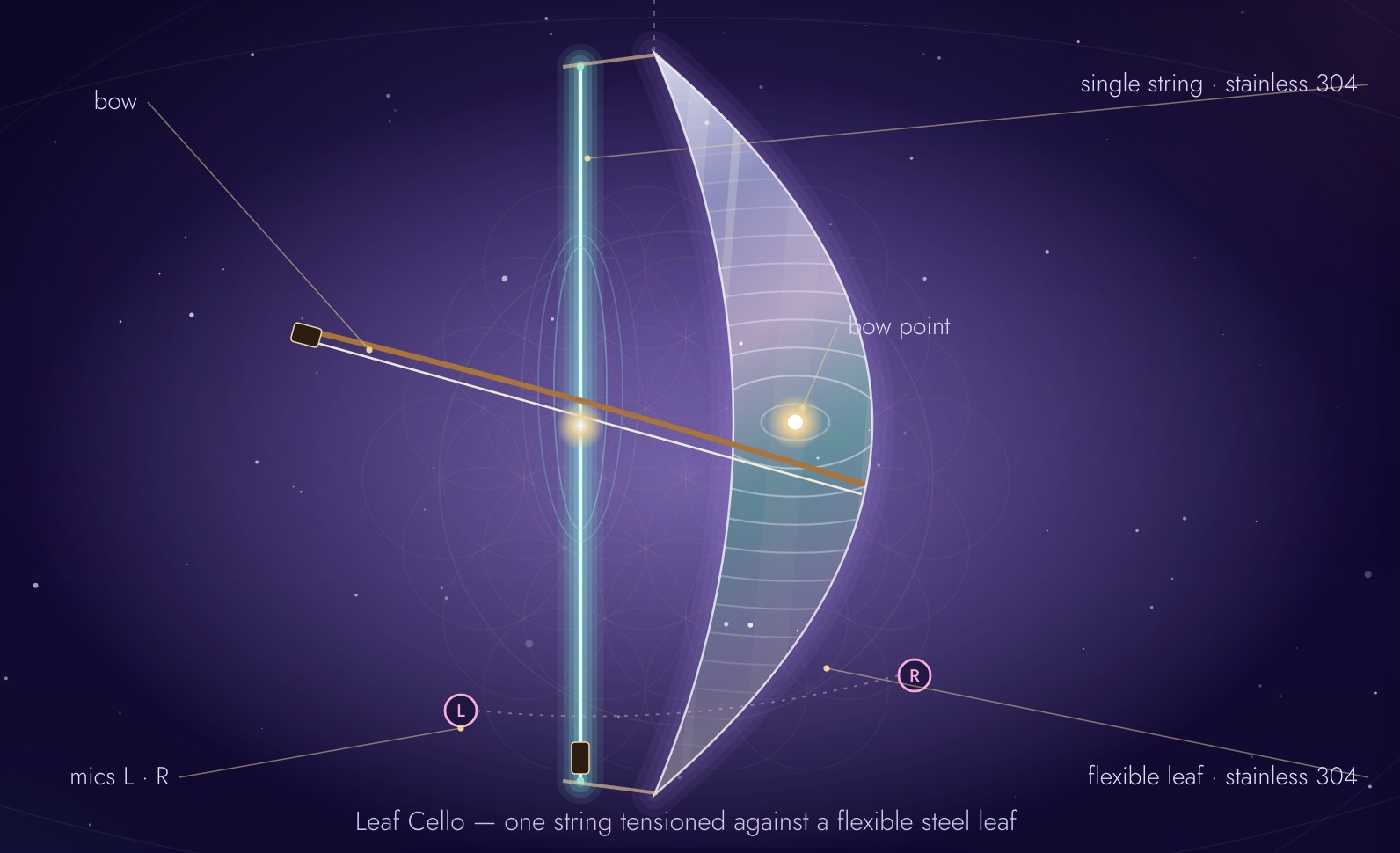
His steel cello stretches a single string across a gently curved sheet of steel, played with a bass bow, and his
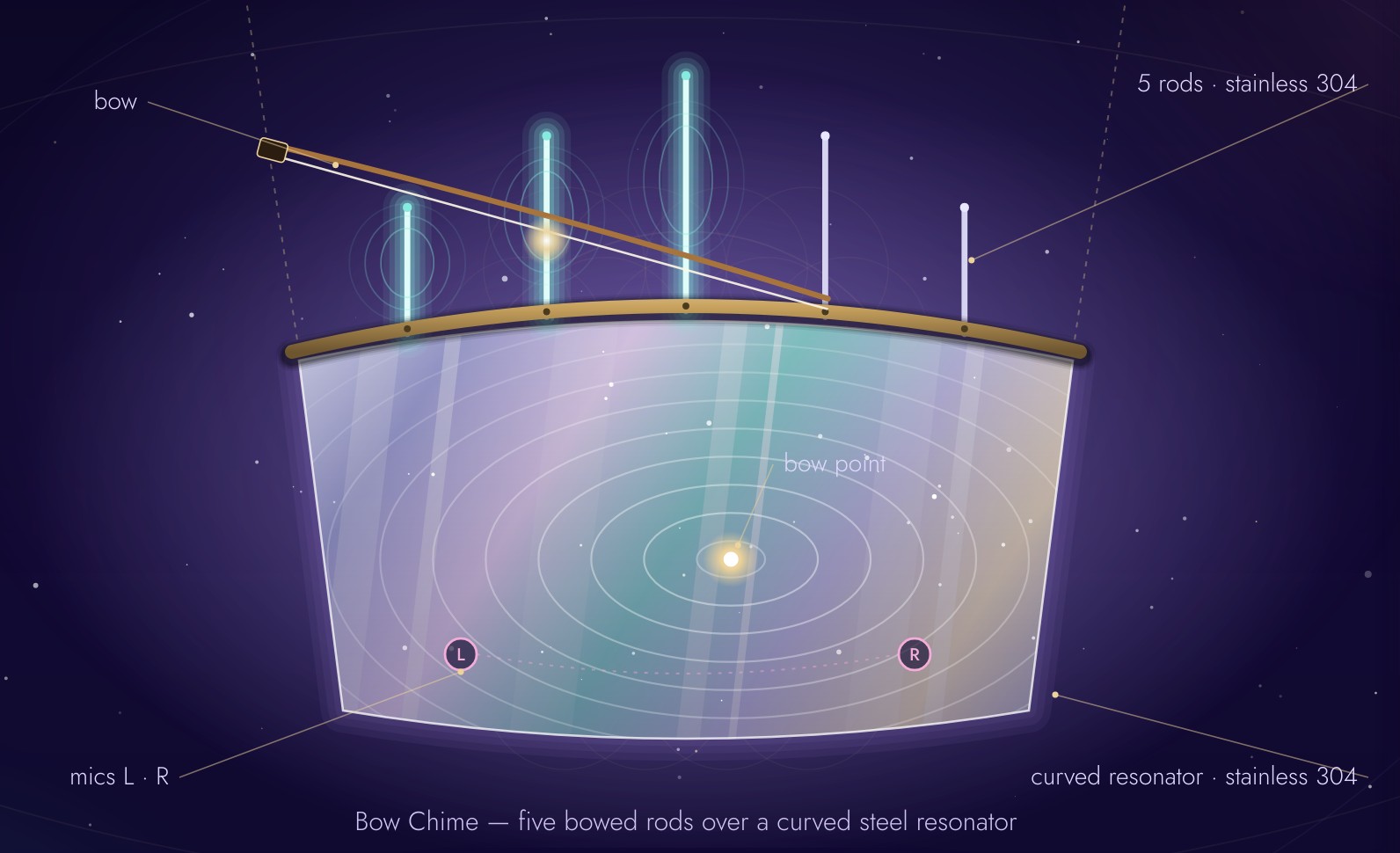
bow chime sets upright metal rods ringing. In 1976 he founded the US Steel Cello Ensemble.
Homage AETHERSTEEL Plugin is an homage created by OM Infinite Sound. It is not affiliated with the
estates of Constance Demby or Robert Rutman.
02Interface overview
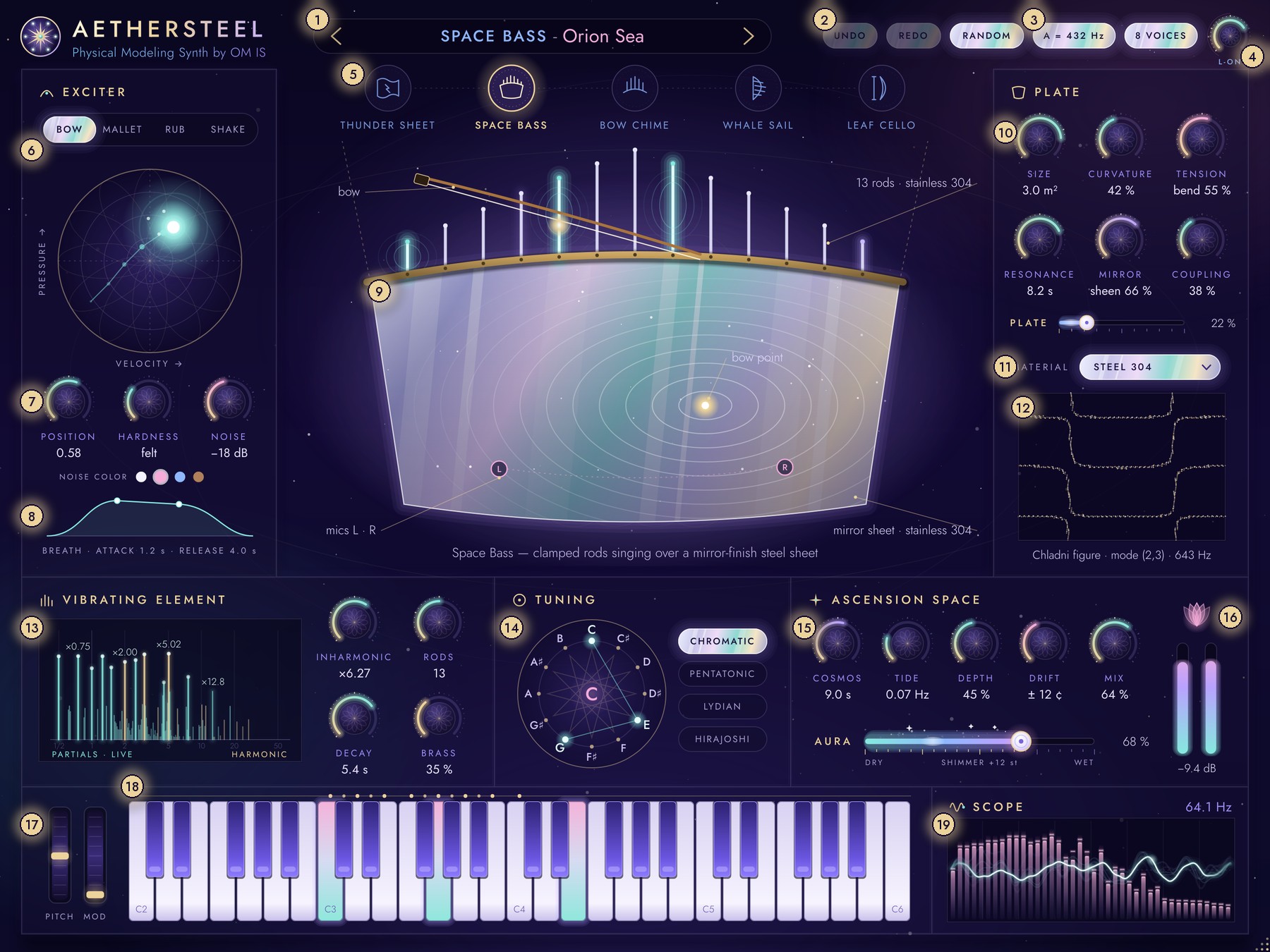
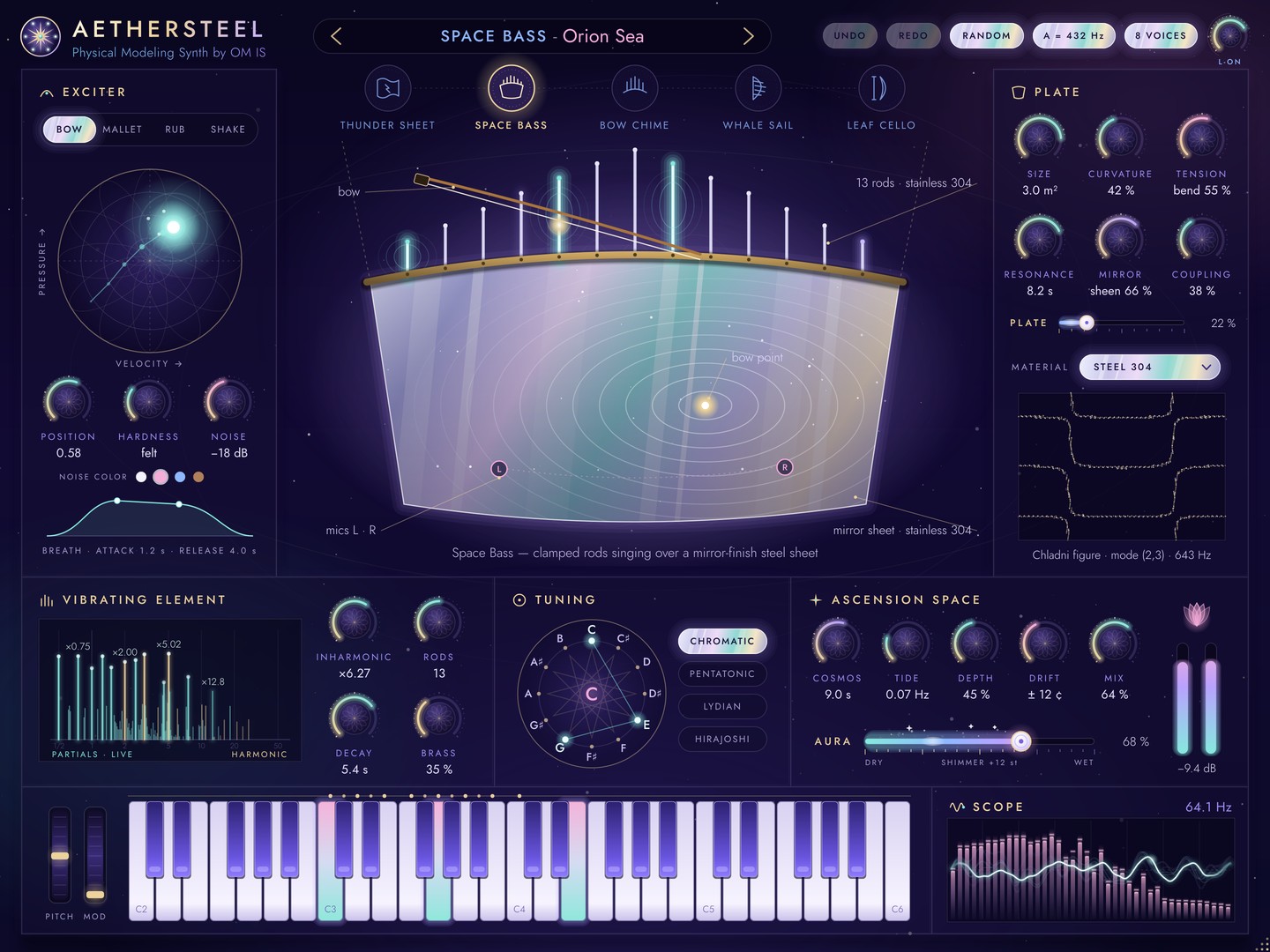
Click to enlarge. Numbers refer to the list below. Every knob: drag to change, double-click to reset.
1Preset browserArrows step through all presets; click the name for the menu
2Undo · Redo · RandomEdit history and a musical patch generator
14TuningTwelve-pointed star, four scales, a tonic for each
15Ascension SpaceCosmos, tide, depth, drift, mix and the Aura fader
16Lotus meterStereo output level and over indicator
17Pitch · ModBend ±2 semitones; vibrato and deeper tide
18KeyboardC2–C6, with dots marking the sympathetic rods
19ScopeWaveform, spectrum and the live tuner
03Five instruments models
Choose a model
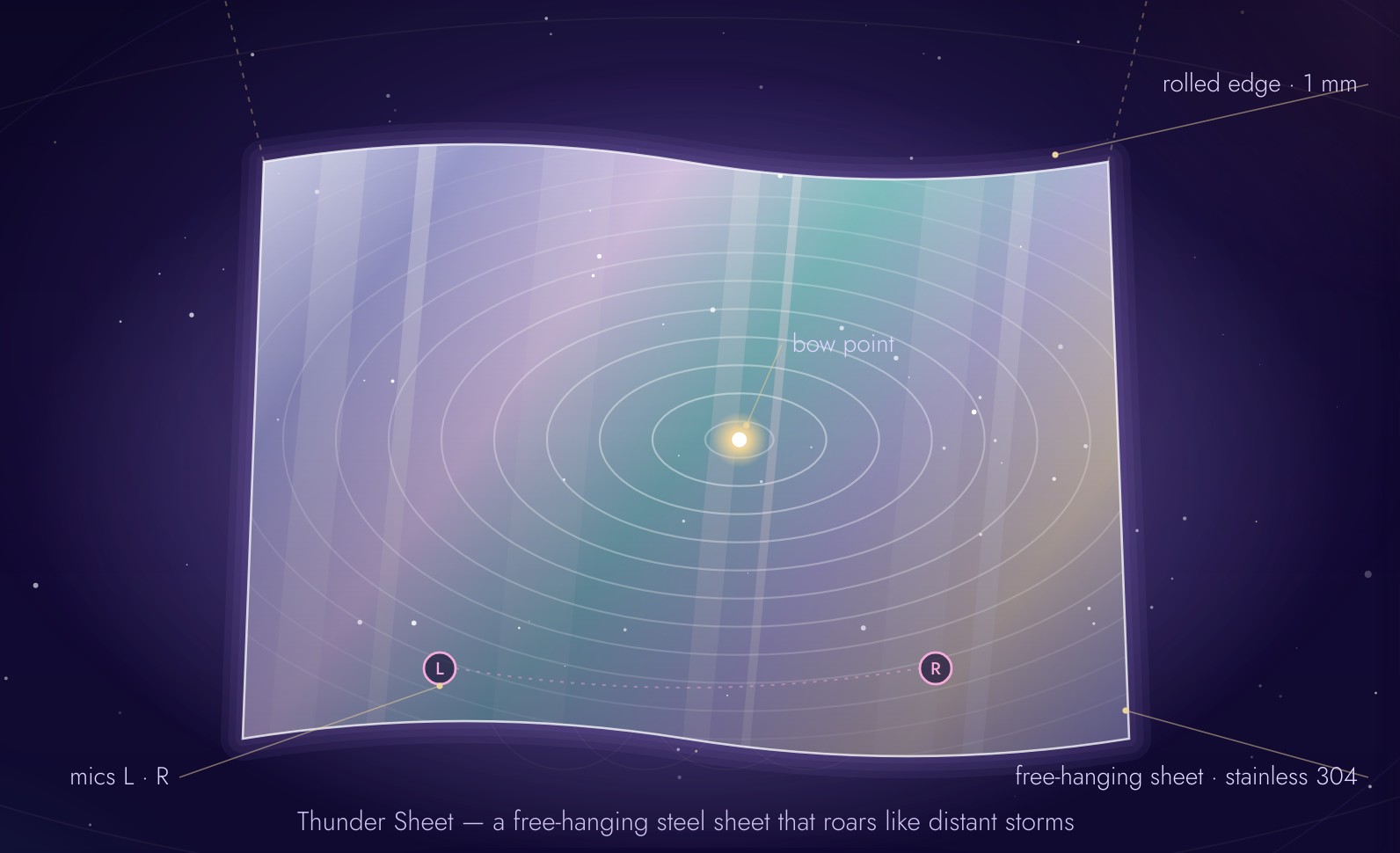
THUNDER SHEET
The stage is not an illustration: drag the bow or rub point along the instrument to change where it is played, and drag the
L and R microphones over the sheet to move the stereo image. The caption under the stage names the current metal.
04With four exciters
How the metal is set in motion
Exciter
Character
BOW
Singing, swelling tones that last while the key is held. Legato in MONO.
MALLET
A percussive strike, then the metal rings freely (DECAY).
RUB
Granular friction by hand: irregular whispers riding on the tone. Legato in MONO.
SHAKE
Clusters of small impacts, like rolling thunder.
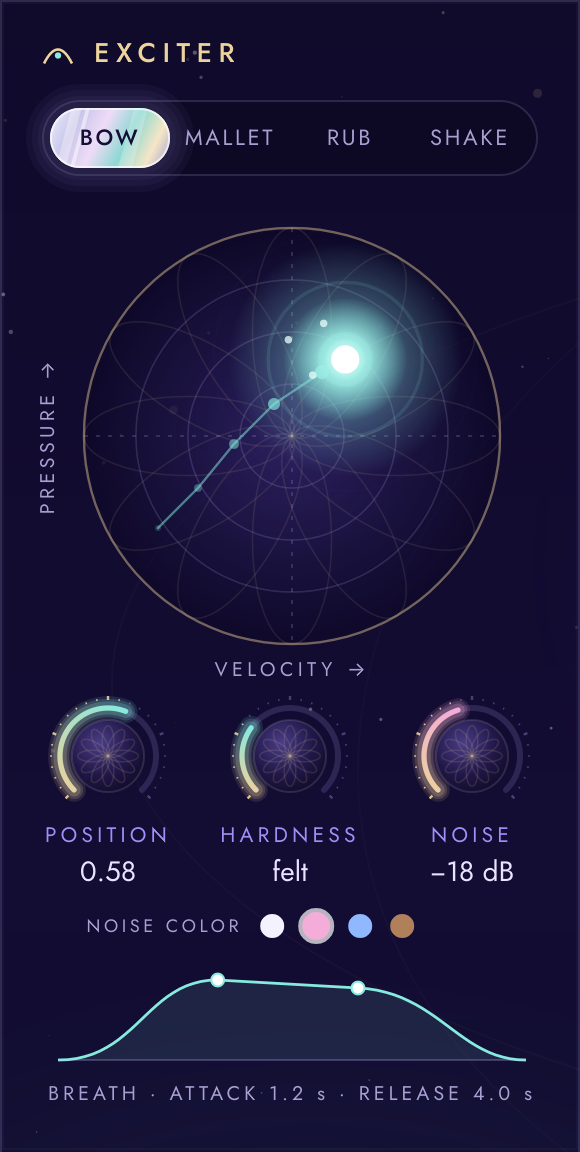
The round pad drives the gesture: horizontal is VELOCITY (bow speed, up to 0.5 m/s), vertical is
PRESSURE. Hard pressure with slow speed growls; light pressure with fast speed whispers.
Control
Range (default)
What it does
POSITION
0–1 (0.58)
Contact point. Near the edge favours high partials; the middle, the fundamental.
HARDNESS
wool → steel (felt)
Wool, felt, rubber, wood, steel. Harder is brighter.
NOISE
off / −31…0 dB (−18 dB)
The breath of the bow, the grit of the strike.
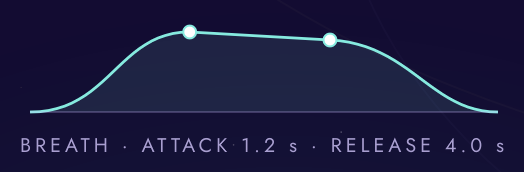
ATTACK
0.01–5 s (1.2 s)
How BOW and RUB swell in.
RELEASE
0.05–20 s (4 s)
Fade after the key is released.
Noise color · listen with your eyes
PINK NOISE−3 dB / octave
Balanced and natural. The default.
Envelope
With BOW and RUB the curve reads BREATH · ATTACK · RELEASE: drag the first node for the attack and the second
for the release. With MALLET and SHAKE the strike is instantaneous, so the curve shows STRIKE · DECAY · RELEASE
and the ring is set by the DECAY knob of the vibrating element.
05Plate & materials
The resonant sheet
Control
Range
What it does
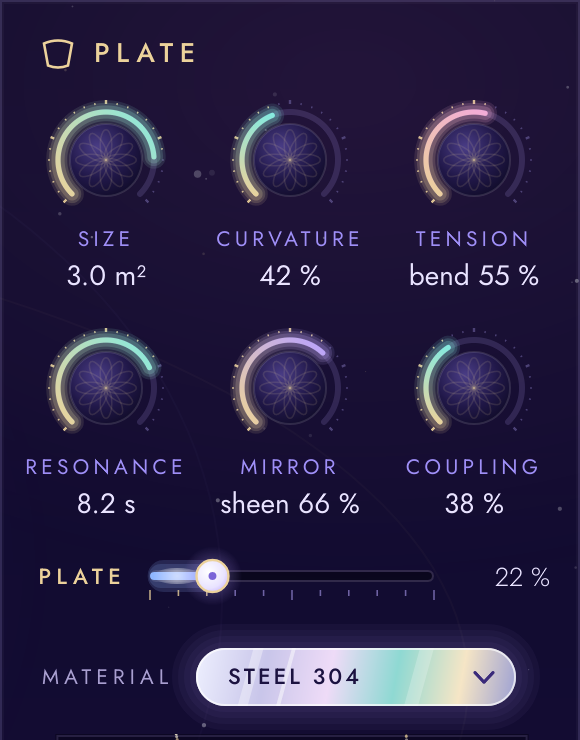
SIZE
0.5–3.55 m²
Sheet area: bigger is deeper.
CURVATURE
0–100 %
Bend of the sheet; widens the stereo image.
TENSION
0–100 %
How hard the sheet flexes while it rings.
RESONANCE
0.2–20 s
Decay time (RT60) of the sheet.
MIRROR
0–100 %
Surface polish: a mirror finish reflects more highs.
COUPLING
0–100 %
Energy the rods feed into the sheet, and back.
PLATE
0–100 %
Fader: how much of the sheet reaches the output.
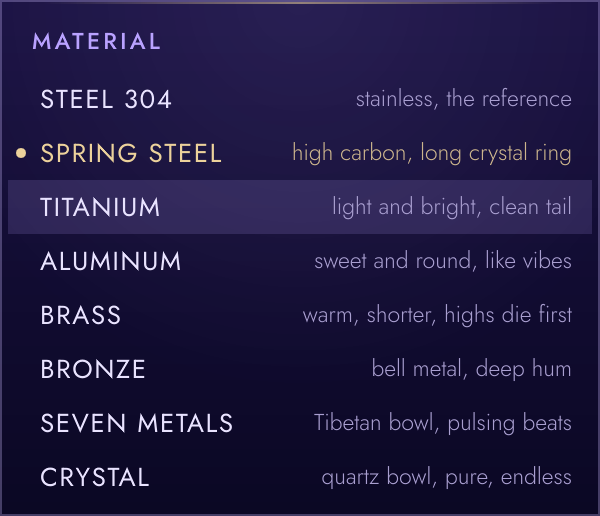
Eight materials · explorer
STEEL 304[ strike ]
Sustain
Brightness
Beating
Stainless, the reference: even, long and neutral.
The iridescent MATERIAL selector changes the metal of the whole instrument, rods and sheet
alike. Each metal has its own decay, overtone level, overtone ratio and detune, and it changes while the notes ring.
Chladni figure · shake the plate
Scatter sand on a vibrating plate and it gathers where the plate stands still: the nodal lines. Grains on the
antinodes keep jumping until they find them. This is Ernst Chladni's experiment of 1787, simulated here with the same
physics. Pick a mode above to scatter the sand again.
In the plugin, the lower display of the PLATE panel draws the figure of the sheet live, following the dominant
frequency of what is actually sounding.
06Vibrating element
Partials · live
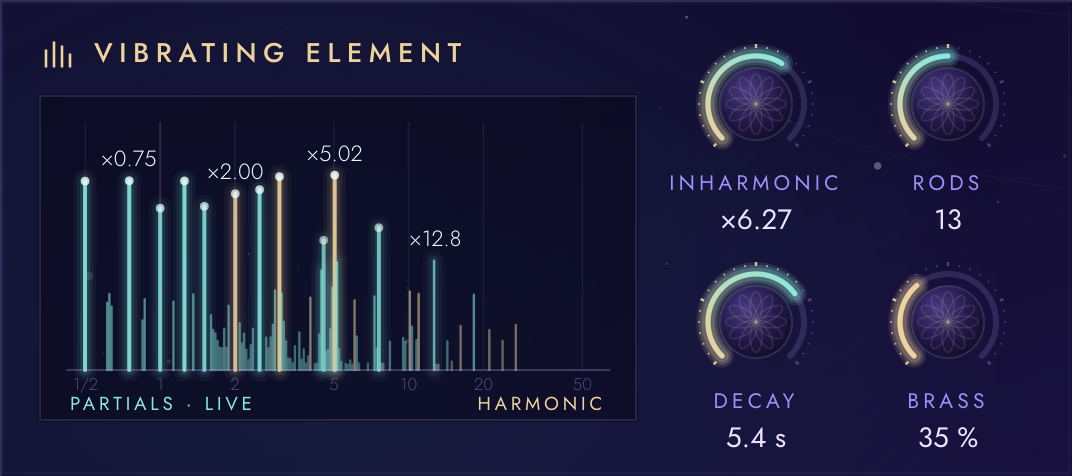
This panel shapes the metal itself. The display shows the real partials of the lowest sounding note as ratios of its
fundamental: on a harmonic instrument they land on the integer marks; on sheets and chimes they spread inharmonically.
All four knobs act on notes that are already ringing.
Control
Range (default)
What it does
INHARMONIC
×1–×9.5 (×6.27)
Ratio of the main overtone: from harmonic to bell-like.
RODS
5–21 (13)
Sympathetic rods, tuned to the current scale and tonic.
DECAY
0.1–15 s (5.4 s)
How long the metal rings after a strike.
BRASS
0–100 % (35 %)
Blends in the warm 2nd and 3rd overtones of brass.
07Tuning scales
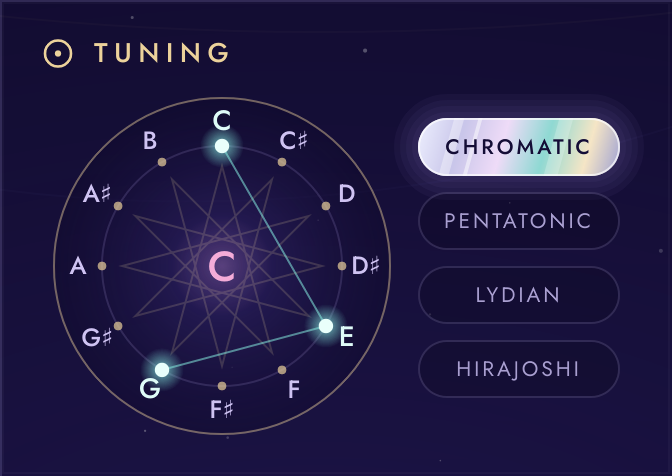
The twelve-pointed star · try it
Click a note on the wheel to make it the tonic, as you would by dragging the star in the plugin.
Each scale remembers its own tonic. Incoming MIDI notes snap to the active scale, so there are no wrong notes, and the
sympathetic rods follow it.
Drag the star up or down, or use the mouse wheel, to move the tonic by semitones. Double-click returns it to C.
Click a scale button to pick that scale's tonic from a menu that previews the notes.
Concert pitch from 400 to 480 Hz, 432 Hz by default, with historical tunings in its menu.
08Ascension Space
Where the instrument becomes cosmic
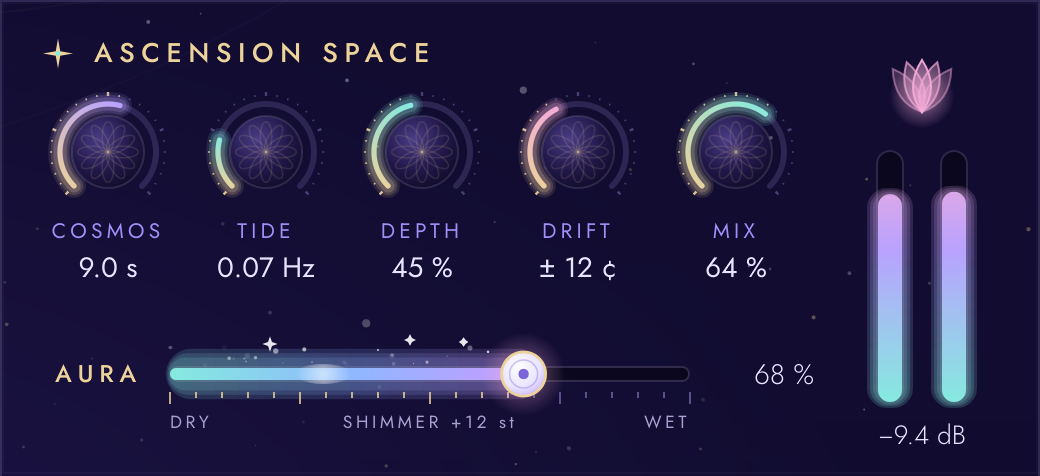
Its heart is AURASHIMMER, the shimmer reverb of the OM IS SYN-8800: an 8-line modulated reverb network whose tail
is continuously pitched up one and two octaves, so long chords bloom into an ascending choir. Around it, a slow
tide breathes through every voice and drift keeps the unison alive.
Control
Range (default)
What it does
COSMOS
0.5–30 s (9 s)
Decay time (RT60) of the shimmer space.
TIDE
0.01–2 Hz (0.07 Hz)
Rate of a slow swell shared by every voice.
DEPTH
0–100 % (45 %)
Depth of that swell: 0 % off, 45 % ≈ 4 dB, 100 % ≈ 11 dB.
DRIFT
0–±30 ¢ (±12 ¢)
Slow random detune per voice: the breathing unison.
MIX
0–100 % (64 %)
Wet trim of the space (64 % = unity).
AURA
0–100 % (68 %)
Fader: amount of shimmer, dry to wet.
Tip The space builds over time: hold a chord for a few seconds, or release it and listen to
what keeps rising. Raise COSMOS and DEPTH for the signature celestial wash.
09In action
A seven-minute journey through the instrument: Space Bass drones, bowed chimes over a seven-metal drone, whale-song
glides, a Lydian steel cello, the eight materials one by one, a thunder storm, the Ascension Space opening up and the
tuning star at work. Every sound comes directly from the AETHERSTEEL engine, with no external processing.