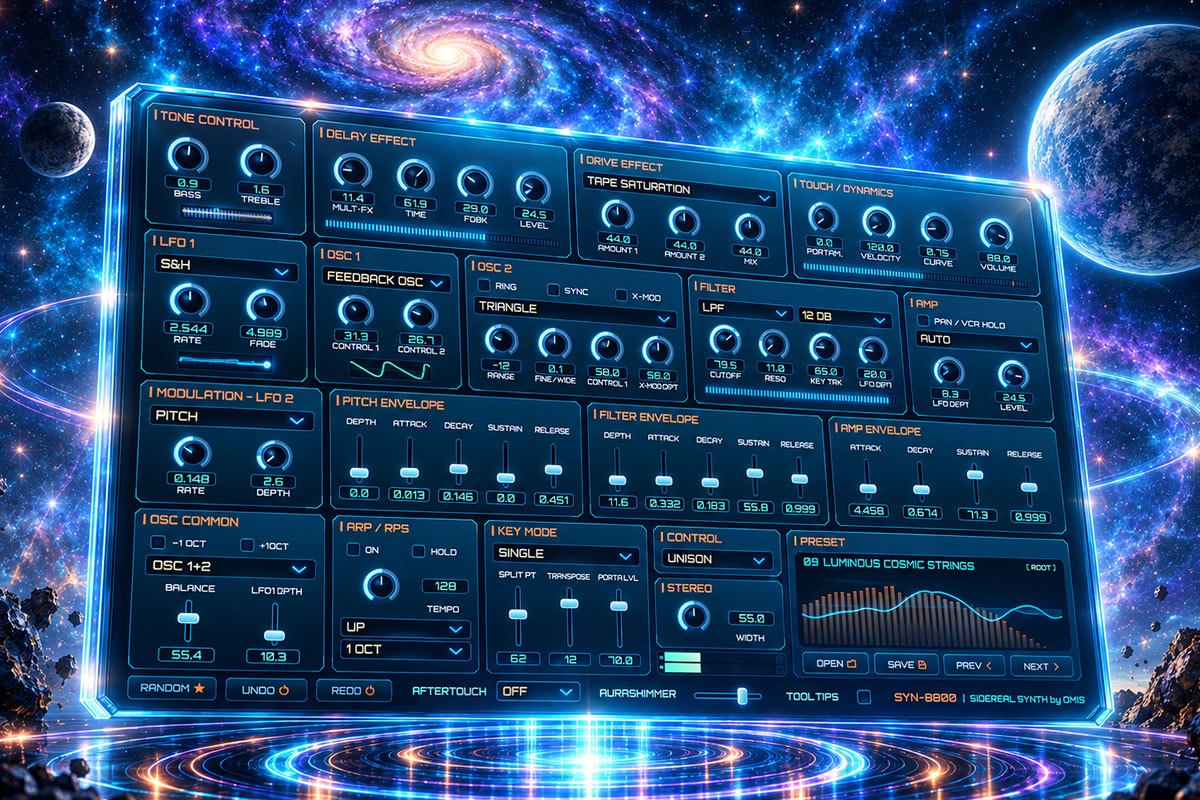
Retro Supersaw power and cosmic depth, built for the modern studio.
SYN-8800 is an analog-modeling polyphonic synthesizer inspired by the classic, massive sounds of the JP-8000 and JP-8080.
It combines a dual-oscillator subtractive synthesis engine with modern features: a rich "Aurashimmer" reverb, four types of oversampled saturation,
random instrument generator, an arpeggiator, and a library of 111 file-based presets that deliver an energetic sound with surprising warmth.
Every control explains itself.
Turn on TOOLTIPS in the footer and hover over any control to see what it does. Below you will find
the full picture of the instrument, but you will rarely need it while you play.
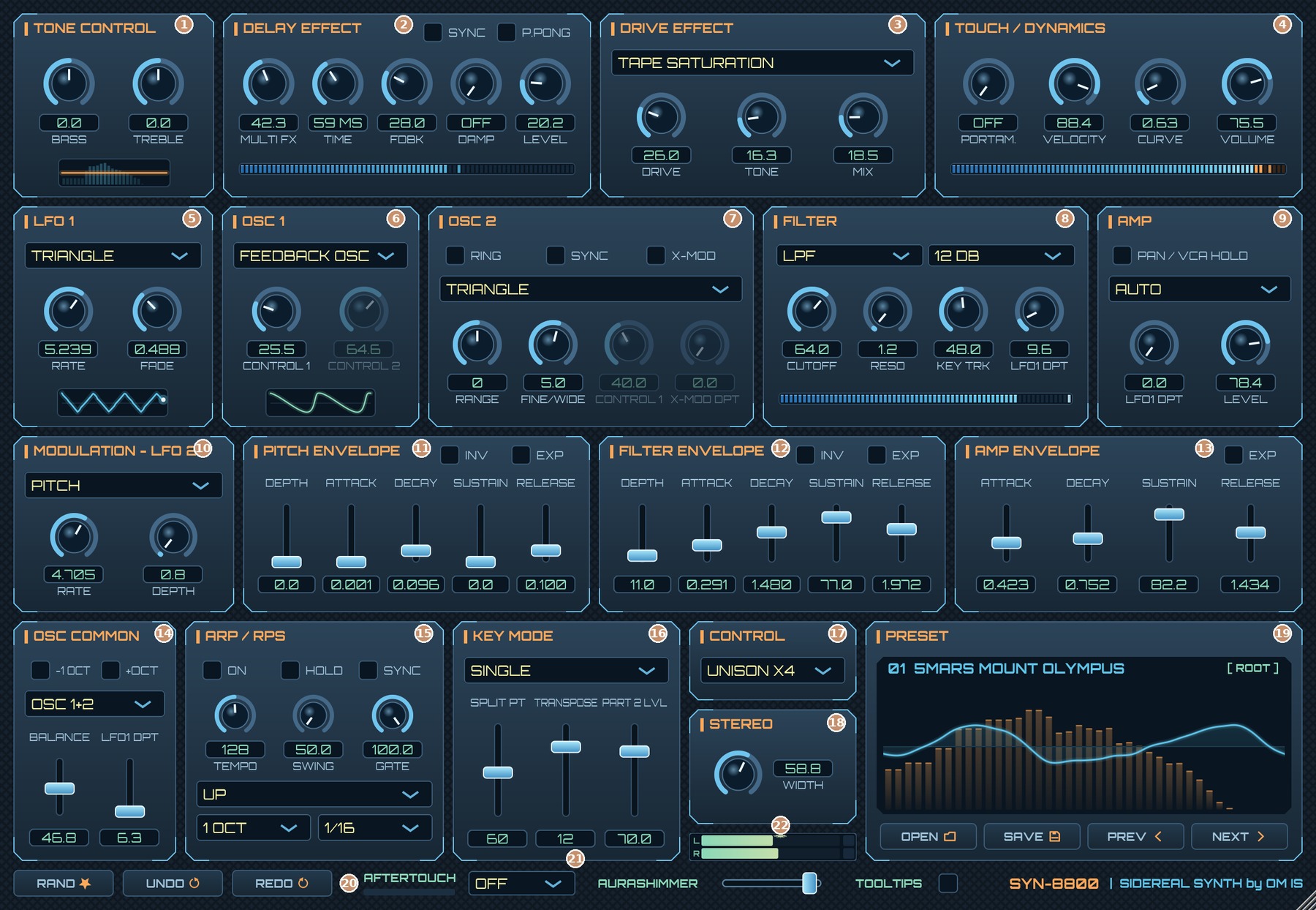
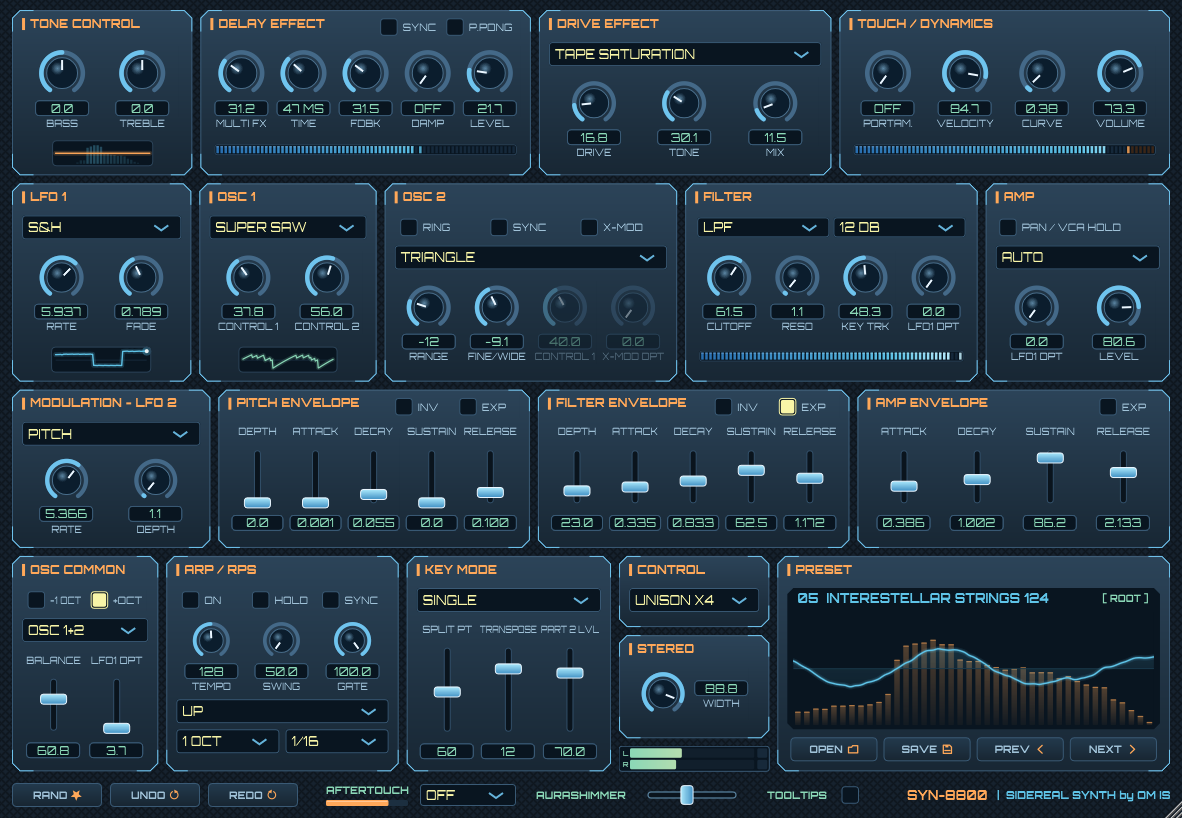
01Interface overview
Click to enlarge. Numbers refer to the list below.
1Tone ControlBass / treble EQ with live response display
2Delay EffectChorus (Multi FX) and delay, with echo meter
3Drive EffectFour saturation types
4Touch / DynamicsPortamento, velocity, volume, output meter
22Level meter (L/R)Final output level and limiter indicator
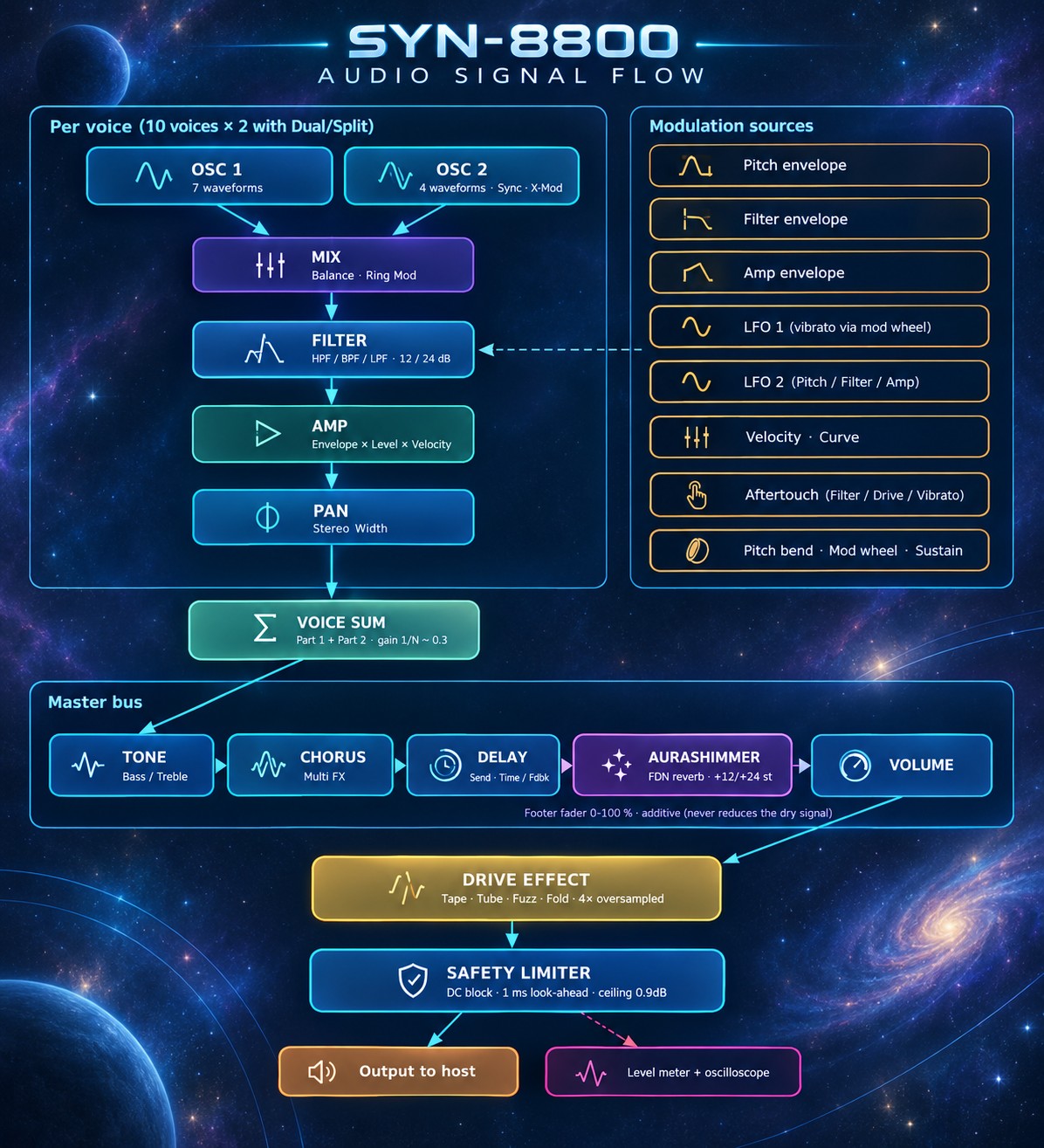
02Signal flow
Each voice mixes OSC 1 and OSC 2, shapes the result with the filter and the amplifier, and places
it in the stereo field. All active voices (plus Part 2 in Dual/Split) are summed with an automatic
voice-count gain and pass through the master bus: Tone, Chorus, Delay and AURASHIMMER.
The Drive Effect follows, then Volume, and a safety limiter is always the final stage.
Note With AMP MODE on AUTO, the voice-count gain keeps dense chords from
overloading: as more notes play, each one is slightly reduced (gain 1/N0.3). Held notes dip
gently when you add more and recover as soon as the extra notes are released. On MANUAL every note
keeps its full level.
03Oscillators
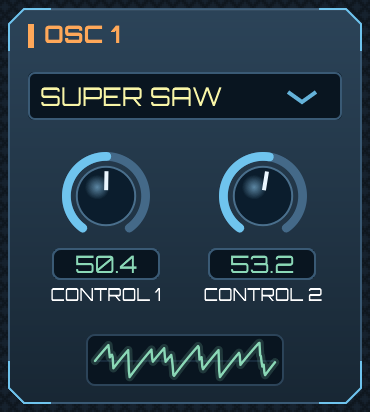
OSC 1 · waveform explorer
OSC 1 is the main sound source. Its two CONTROL knobs change meaning with the selected waveform,
and the display under the knobs shows the waveform the engine actually produces, with both controls
applied. Pick a waveform below to see it move:
SUPER SAW[ OSC 1 ]
Control 1Detune
Control 2Mix of side saws
CharacterSeven detuned, band-limited saws: the classic trance and pad sound.
Tip Super Saw detune follows an exponential curve, so the whole knob is
usable: around 25 gives a subtle chorus (±17 cents), 35–55 the lush classic spread (±30–110 cents),
60–75 a very wide sound (±140–320 cents), and the top of the range a dissonant spread of up to an
octave, useful for effects.
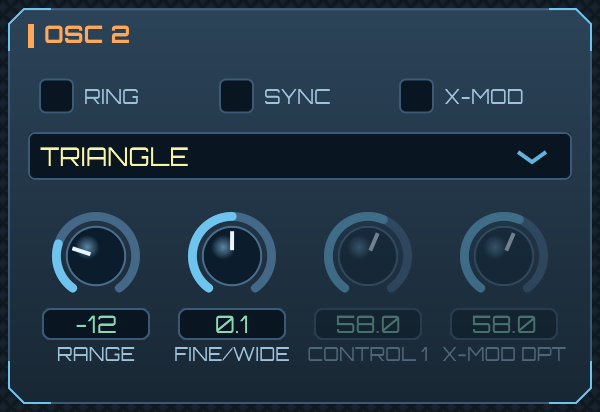
OSC 2
Control
Function
WAVEFORM
Square (PWM), Saw, Triangle or Noise.
RING
Ring modulation: OSC 1 × OSC 2. Metallic, bell-like tones.
SYNC
Hard sync: OSC 2 restarts with every OSC 1 cycle. Sweep RANGE for classic sync leads.
X-MOD
OSC 1 modulates the frequency of OSC 2, depth set with X-MOD DPT.
RANGE
Coarse tuning, −24 to +24 semitones.
FINE / WIDE
Fine tuning, ±1 semitone at the extremes. Small values thicken the sound.
CONTROL 1
Pulse width when the waveform is Square (PWM).
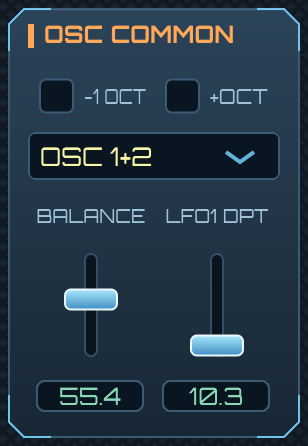
OSC Common
Control
Function
-1 OCT / +OCT
Shift both oscillators one octave down or up.
LFO1 & ENV DEST.
Where LFO 1 vibrato and the pitch envelope act: OSC 1+2, OSC 2 only, or X-Mod.
BALANCE
Mix between OSC 1 (0) and OSC 2 (100).
LFO1 DPT
Maximum LFO 1 vibrato depth, brought in with the mod wheel.
04Filter, amp & envelopes
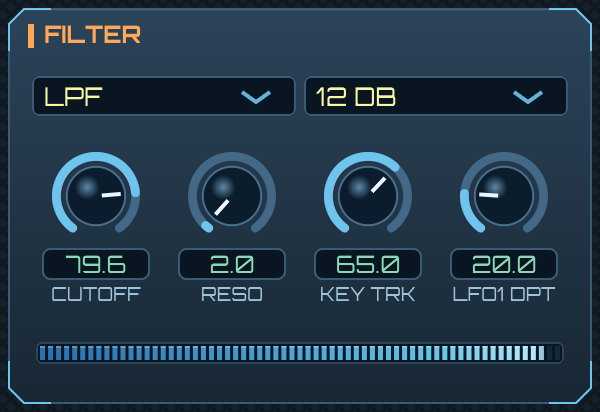
Filter
Control
Range
Function
TYPE
HPF / BPF / LPF
High-pass, band-pass or low-pass.
SLOPE
12 / 24 dB
24 dB is twice as steep on all three types: darker LPF, thinner HPF, narrower BPF band.
CUTOFF
20 Hz–18 kHz
Logarithmic scale.
RESO
0–100
Emphasis around the cutoff.
KEY TRK
0–100
At 100 the cutoff tracks one octave per octave.
LFO1 DPT
0–100
LFO 1 on the cutoff, up to ±4 octaves.
The filter envelope can open the cutoff up to +6 octaves, and aftertouch up to
+5 octaves. In 24 dB mode the filter is a 4-pole Butterworth cascade with a single resonant peak, so
resonance behaves consistently in both slopes.
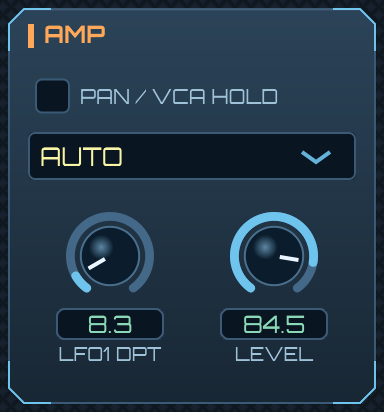
Amp
Control
Function
PAN / VCA HOLD
Released notes keep sounding at the sustain level until the voice is reused (drone and organ-style hold).
AMP MODE
AUTO: each note is lowered as more notes play, so dense chords never overload. MANUAL: every note keeps its full level; the safety limiter still guards the ceiling.
LFO1 DPT
LFO 1 tremolo on the volume.
LEVEL
Output level of the voice amplifier.
Envelopes · try the ADSR
Three ADSR envelopes, each with its own section and vertical faders: Pitch (up to +24
semitones), Filter (up to +6 octaves) and Amp (always full). Every stage ranges from
1 ms to 10 s. EXP (right of each title) switches an envelope to analogue-style curves with the same times; INV flips the Pitch or Filter envelope. Move the faders below to see the shape:
AMP ENVELOPE[ 2.1 s ]
LFOs
LFO 1
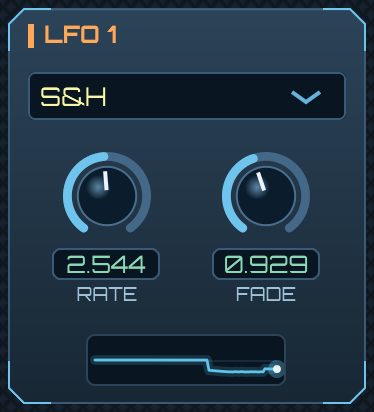
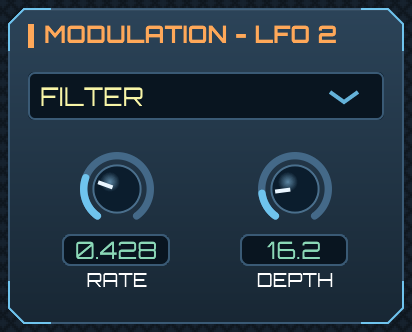
Waveform Triangle, Saw, Square or S&H · Rate 0.02–20 Hz · Fade 0–10 s
(delayed vibrato).
Three destinations, each with its own depth: pitch (through the mod wheel), filter cutoff and
volume. The display follows the sounding note's LFO exactly, including the fade-in and S&H steps.
On pitch, 100 equals ±12 semitones: use small values (around 1) for a natural vibrato.
Note Pitch vibrato from LFO 1 only acts through the mod wheel: with the wheel at
zero there is no vibrato, whatever the depth setting.
05Effects
AURASHIMMER · signature effect
A lush reverb whose tail keeps rising in pitch as it rings, turning short notes into radiant,
evolving pads. The footer fader sets the amount: 0 % is off, about 70 % is the classic
level and 100 % is even more lush. It is saved with each preset, can be automated, and a
double-click returns the fader to 70 %.
Reverb engine
8-line feedback delay network with Hadamard mixing and slow line modulation, plus input diffusion. A dense, smooth tail without metallic resonances.
Shimmer
+12 semitones (main layer) and +24 semitones (subtle sparkle), fed back so each pass rises higher.
Tone
Feedback filtering and a gentle high-shelf keep the tail warm instead of piercing.
Decay
Long tail of about 9 seconds.
Mix
Additive: the tail is added on top of the dry sound and never reduces it.
Tip AURASHIMMER builds over time: hold a chord for a few seconds, or
release it and listen to what keeps ringing. It shines on plucks, pads, strings and slow melodies.
Drive Effect
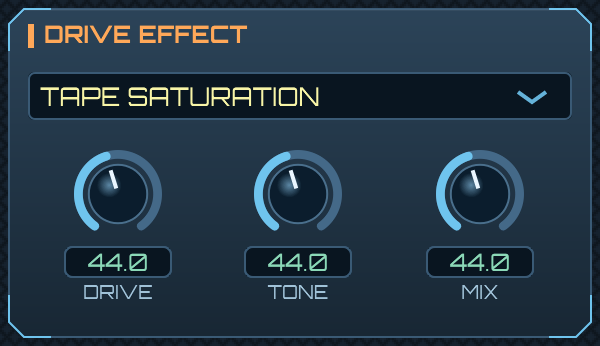
A saturation stage after the master bus, with four characters modeled on the circuits they are
named after. Everything runs 8× oversampled to avoid harsh digital aliasing, and an automatic
gain match means DRIVE changes the character, not the volume.
Type
Character
TAPE
Record/playback emphasis, soft transient compression, low-end head bump, gentle high loss. Warm and glued.
TUBE
Two asymmetric triode stages: strong 2nd harmonic and a level-dependent "bloom". Warm and rich.
FUZZ
Germanium-style rounded clipping with a Big Muff-style mid scoop. Thick and aggressive.
FOLD
Smooth sine wavefolder: complex, evolving harmonics without harshness.
DRIVE drive · TONE tone (higher is darker) · MIX dry / saturated balance.
Delay Effect · Chorus and Delay
Control
Function
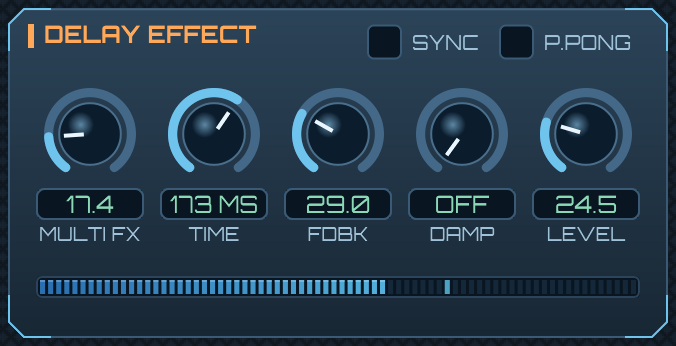
MULTI FX
Chorus level: a stereo chorus that widens and animates the sound.
TIME
Delay time (shown in ms), 10 ms to 1 s. Changes glide smoothly, like tape.
FDBK
Feedback: number of repeats.
DAMP
Darkens each repeat, like tape or an analogue delay: the first echo stays bright, every one after it loses more top. 0 = OFF.
LEVEL
Level of the echoes, added on top. The dry signal is never reduced.
SYNC
TIME follows the DAW tempo: the knob picks a note value from 1/32 to 1/1 (T = triplet, D = dotted). Without host tempo it uses ARP TEMPO.
P.PONG
Ping-pong: the echoes bounce left, right, left… The input is summed to mono first.
The blue meter in this box shows the level of the echoes alone, so you can watch the repeats fade.
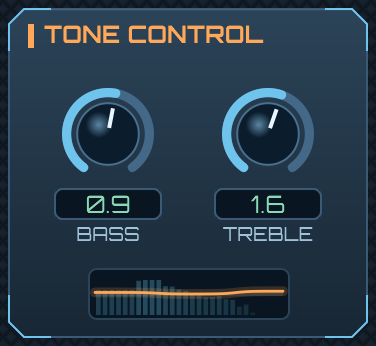
Tone Control
BASS and TREBLE are shelving equalizers of ±12 dB at 200 Hz and 3.5 kHz, applied to the full
mix. The display draws the resulting EQ curve (orange) over a live spectrum analyzer of the output.
06Presets
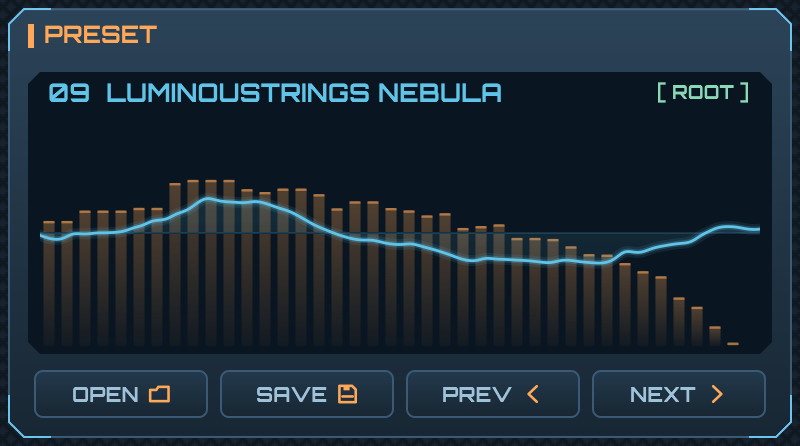
Preset screen
The preset name, its folder in square brackets and a live oscilloscope of the output. Behind the
waveform, soft orange bars show the spectrum of the same signal: 40 bands from 30 Hz to 16 kHz.
OPEN any .syn8800preset file, starting in the folder you are working in.
SAVE the current sound, suggesting its name so you can overwrite it in one click.
PREV / NEXT browse the presets in the current folder.
Random · Undo · Redo
RAND first picks a sound family (pad, strings, pluck, bass, lead, brass or keys) and then sets
every parameter within ranges suited to it, so results sound like instruments rather than noise.
UNDO / REDO cover parameter changes, presets loaded and RAND, until the plugin is closed.
Factory library · 111 presets
[ ROOT ]11
CABIN 0140
CABIN 0240
CABIN 0320
Pads and strings, basses and sub-basses, leads, plucks, harps and bells, keys, pianos and organs, brass,
voices, arpeggios, atmospheres and sound effects. Most names start with their category, so presets of
the same type sit together. Factory presets are never overwritten: save edited versions under a new
name or in a folder of your own.
07In action
A walkthrough of some of the 111 factory presets folders. Featuring melodies with a retro, cosmic, and futuristic vibe.
The sound comes directly from the SYN-8800 audio engine, with no external processing or effects applied.